
Analysis
Double Jersey Match Premiums: 22 Recent eBay Sales
The rarest serial trait we've looked at, and the biggest premium. Typical sale: 187% over the previous comp. 21 of 22 sold above their comp. A smaller, Judge-heavy sample than our 100-sale studies, so read it as an early signal. Full breakdown below.
Published July 17, 2026
A jersey match is a card whose serial numerator matches the player's jersey number, like a LeBron numbered 23/99. A bookend is the last copy of a print run, where the numerator equals the denominator, like a 99/99. A double jersey match is both at once: X/X where X is also the player's jersey number. Aaron Judge wears 99, so a Judge 99/99 is a double jersey match. Bo Nix wears 10, so a Nix 10/10 qualifies.
These are genuinely rare. The denominator has to equal the player's number, so a double jersey match can only exist when a card is printed to a run that happens to be that player's jersey number. After our jersey match premium analysis did well, people asked what these "double" matches are worth. So we pulled every recent sale we could find and compared each to the most recent non-match copy of the same card.
Read this as an early look, not a definitive study.
Our jersey-match and bookend articles each used 100 sales. Double jersey matches are rare, so this is 22. Five of the 22 are Aaron Judge 99/99 cards, which pull the average up. The signal is strong and consistent, but the sample is smaller and more concentrated, and we call out where that matters.
The short version: double jersey matches command the largest premium of any serial trait we've measured. The typical sale went for 187% over the previous comp (roughly triple), 21 of 22 sold above their comp, and 14 of 22 doubled or more. Only one sold below its previous comp.
Methodology
For each of the 22 completed eBay sales, I required:
- The card was a double jersey match: numerator and denominator both equal the player's jersey number (Judge 99/99, Nix 10/10, Mahomes 15/15).
- A comparable non-match sale of the exact same card (same year, set, player, parallel, print run).
- The comparison sale was NOT itself a jersey match.
The premium is (double match price - previous comp) / previous comp. A 100% premium means the double match sold for double the comp. And a note on scale: 22 sales is a small sample, so single cards move the numbers more than they would in the 100-sale studies. Treat every figure here as approximate.
Headline: 21 of 22 sold above their comp
21 out of 22 double jersey matches sold for more than their most recent non-match comp. Only one sold below. That above-comp rate is even higher than the 87% we saw for regular jersey matches, though on a much smaller sample. The chart below shows how the 22 sales were distributed by premium size.
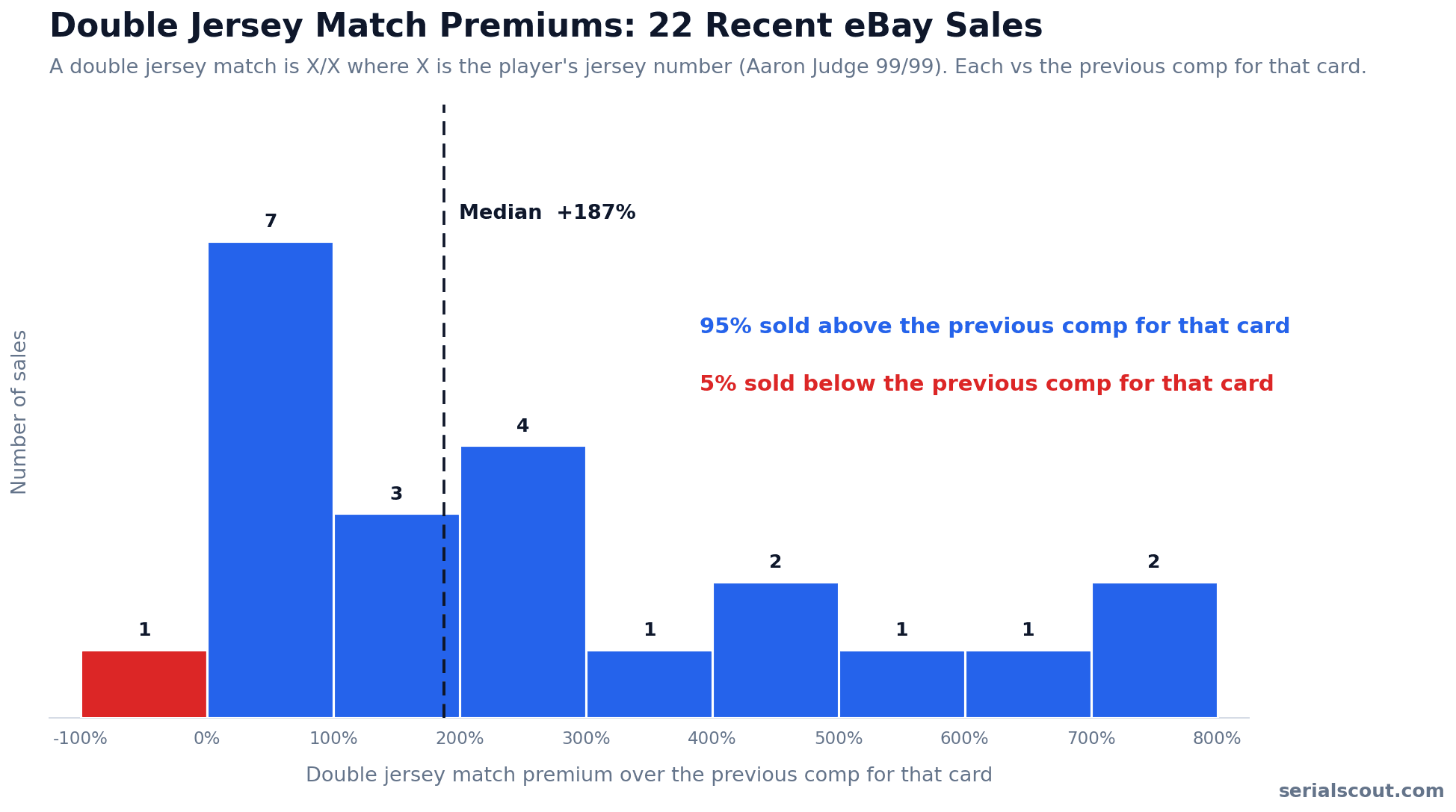
The typical premium is 187%, roughly triple the comp
The spread across the 22 sales:
- Typical (median): 187% premium, or about 2.9x the comp
- Average (mean): 246%, pulled up by the big Judge sales
- 25th percentile: 35%
- 75th percentile: 412%
For comparison, our 100-sale jersey match study found a typical premium of 60%, and the bookend study found 20%. Double matches sat far above both here. The middle half of sales ran from a 35% to a 412% premium, a very wide band, which is partly the small sample and partly a genuinely volatile, novelty driven corner of the hobby.
The Aaron Judge effect
The single biggest caveat in this data has a name: Aaron Judge. He wears 99, and cards printed to /99 are everywhere, so Judge 99/99 double matches show up far more than any other player. Five of the 22 sales are Judge 99/99, and they had a median premium of 447%, well above the group. The hottest player-number combo in the hobby is doing a lot of the work.
So the honest test is what happens without him. Strip out the five Judge cards, and the other 17 sales still had a median premium of 125% over the previous comp. That is lower than the headline 187%, but still more than double what a regular jersey match commands. The core finding holds without Judge: double matches are a large premium. Judge just makes it look even larger.
Cheaper cards, bigger percentage premiums
The same pattern from the jersey match and bookend studies shows up again. Broken out by the price of the comparable sale:
- Comp of $100 or less: median premium around 315%
- Comp over $100: median premium around 30%
A cheap card with a $25 comp can jump to $200 on a novelty like a double match, a 700%+ swing, far more easily than an expensive card can move in percentage terms. On higher-priced cards, buyers anchor harder and the percentage premium compresses, even though the dollar gain can still be real.
The wins: double matches that popped
The biggest premiums in the sample:
- +740%: 2024 Contenders Joe Milton 19/19 Rookie Ticket Stub Auto: $25.00 → $210.00
- +725%: 2025 Topps Finest Reflash 10/10 Black Refractor: $31.51 → $260.00
- +661%: 2026 Bowman Aaron Judge 99/99 Green: $37.00 → $281.50 (Judge wears 99)
- +539%: 2026 Donruss Aaron Judge 99/99 Jersey Kings: $15.50 → $99.00
- +447%: 2025 Topps Pristine Aaron Judge 99/99 Purple: $22.50 → $123.00
Three of the top five are Judge, which is the concentration point again. The Joe Milton and Topps Finest sales show the effect is not Judge-only, but he dominates the very top.
The one loss
Only a single card sold below its comp:
- -17%: 2024 Panini Immaculate Christian Pulisic 10/10 USMNT: $120.00 → $100.00
It fits the pattern from the other studies: it was one of the pricier cards in the set (a $120 comp), and on higher-priced cards the double-match novelty is a smaller share of the total value, so it does less to lift the price. With only one loss in 22, though, there is not much to generalize from. A larger sample would certainly turn up more.
How double matches compare
Stacking the three studies side by side, with the sample-size caveat firmly in mind:
- Bookends (100 sales): typical premium 20%, 63% above comp
- Jersey matches (100 sales): typical premium 60%, 87% above comp
- Double jersey matches (22 sales): typical premium 187%, 95% above comp
The ladder is intuitive: each step adds rarity and novelty, and the premium climbs with it. Just remember the last rung stands on a quarter of the data and leans on Aaron Judge. For the full head-to-head on the first two, see our bookend vs jersey match comparison.
What this means for buyers and sellers
If you're selling a double jersey match: it is worth calling out explicitly in the title, because the novelty is the whole draw and most buyers will not spot X/X on their own. Anchor on the previous comp and expect a large premium, but do not treat the 187% median as a promise on a single card, especially off a 22-sale sample.
If you're buying: the premium is real but the data is thin, so lean on the comp for that specific card rather than a blanket multiple. The cheaper the base card, the more the percentage can run.
If you're chasing them: they are hard to find, because the card has to be printed to a run equal to the player's number. The most common target by far is a /99 card of a player who wears 99, which is why Aaron Judge dominates.
Finding double jersey matches on Serial Scout
The hard part is finding them. A double match hides in plain sight: a listing might read "2026 Bowman Aaron Judge Green /99" without mentioning that this particular copy is stamped 99/99. Keyword searching cannot catch that.
Serial Scout indexes serial-numbered listings by exact numerator and denominator, so you can search for a specific X/X directly. Browse every Aaron Judge jersey match currently on eBay, then look for the 99/99 copies, or start from the homepage and search any player and print run.
Common questions
What is a double jersey match card?
A double jersey match is a serial-numbered card where both the numerator and the denominator equal the player's jersey number, written X/X. Aaron Judge wears 99, so a Judge card numbered 99/99 is a double jersey match. Bo Nix wears 10, so a Nix 10/10 qualifies. It is the last copy of the print run (a bookend) and a jersey match at the same time, which makes it far rarer than a regular jersey match.
How much do double jersey match cards sell for?
In this first look at 22 recent eBay sales, the typical (median) double jersey match sold at a 187% premium over the most recent comparable non-match copy of the same card, meaning it roughly tripled the previous comp. 21 of the 22 sold above their comp, and 14 of 22 doubled or more. This is a small sample and it leans on Aaron Judge 99/99 cards, so treat it as a directional signal rather than a precise figure.
Is the sample big enough to trust?
It is smaller and less rigorous than our jersey-match and bookend analyses, which each used 100 sales. Double jersey matches are genuinely rare, so 22 is what a careful search turned up. Five of the 22 are Aaron Judge 99/99 cards, the single hottest player-number combination in the hobby, which pulls the average up. The signal is strong and consistent, but read it as an early finding, not a definitive study.
Does the premium hold up without Aaron Judge?
Mostly, yes. The five Aaron Judge 99/99 cards had a median 447% premium and skew the overall number. But the other 17 sales, with no Judge, still had a median premium of 125% over the previous comp. So even setting Judge aside, double jersey matches in this sample commanded far more than a regular jersey match, which ran a median 60% in our larger study.
How was this data collected?
22 completed eBay sales of double jersey match cards (numerator and denominator both equal to the player's jersey number), each paired with the most recent comparable non-match sale of the exact same card. The premium is calculated as (double match price - previous comp price) / previous comp price.
Start exploring
Browse serial-numbered cards by player on Serial Scout, or read the companion pieces: our 100-sale jersey match analysis, our bookend premium analysis, and the explainer on jersey match cards.