
Guide
What Is a Bookend Card in Sports Card Collecting?
The first and last copies of any print run sell for a premium. Here's how much, why collectors chase them, and how to find the ones available on eBay right now.
Published July 4, 2026
A bookend card is the first copy (1/X) or the last copy (X/X) of a print run. On a card numbered to 99, the bookends are 1/99 and 99/99. On a card numbered to 25, the bookends are 1/25 and 25/25. They're called bookends because they sit at the two ends of the sequence, framing the print run like a pair of bookends on a shelf.
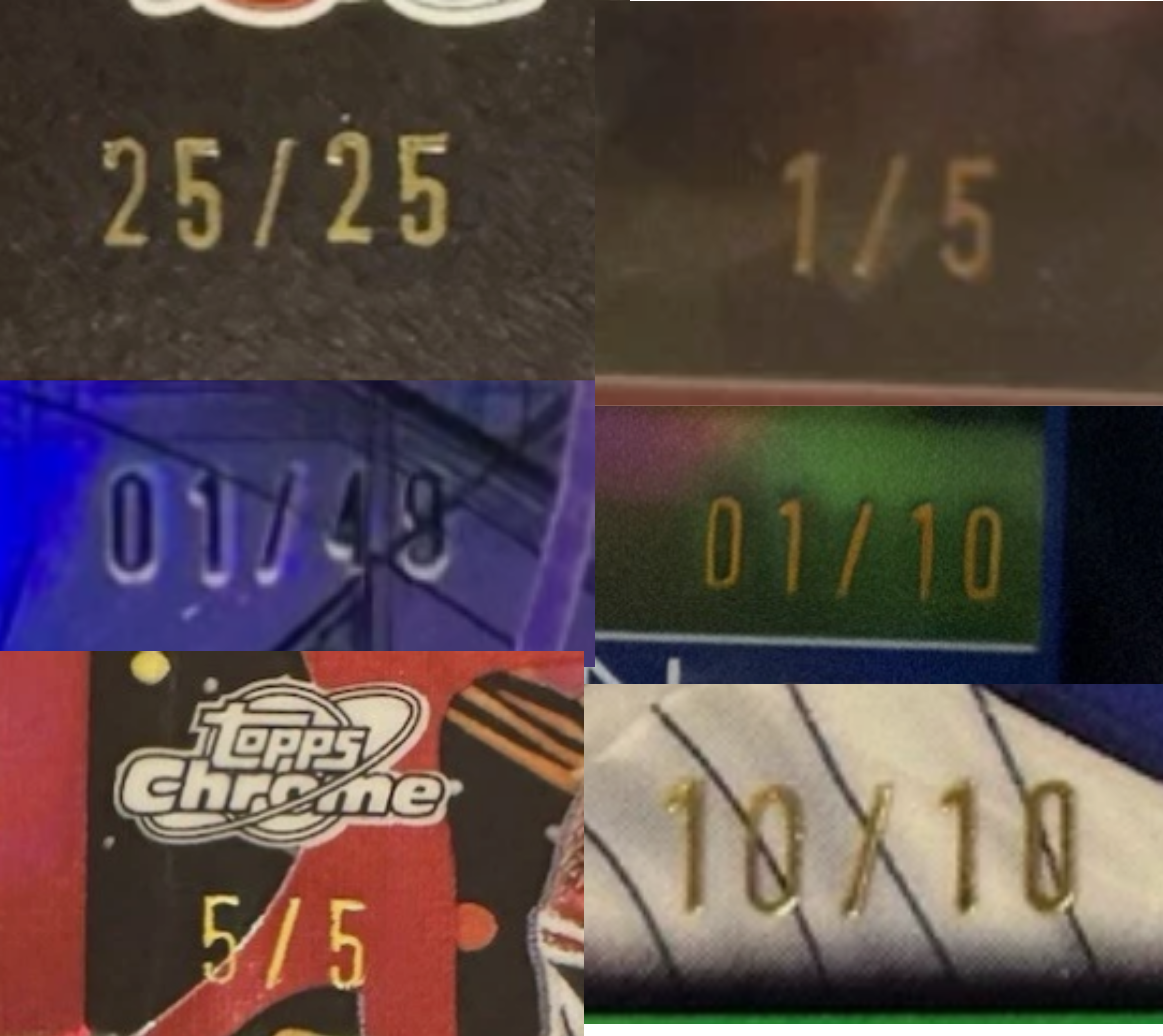
1/X) and last copies (X/X) count, across every print run.Why bookends matter
For any print run, most copies sell for roughly the same price. A 5/99 and a 47/99 of the same card, in the same condition, go for about the same money. The exceptions are the copies that carry some intrinsic meaning, and bookends are one of the most reliable categories of that.
The pitch is simple: 1/99 was the first copy of that parallel to come off the press. 99/99 was the last. There's only one of each, and collectors treat them as slightly more prestigious than any middle-of-the-run copy. That prestige translates to a resale premium.
How much premium do bookends actually sell for?
The typical range is 10% to 30% over an equivalent off-number copy. So if a mid-run 47/99 sells for $200, the 1/99 or 99/99 might sell for $220 to $260. The premium tends to be higher for:
- Lower print runs. A 1/10 carries a bigger percentage premium than a 1/500, because scarcity amplifies every serial-based signal.
- Higher-demand players. Rookie stars and all-time greats have deeper buyer pools, and buyers with bigger budgets tend to care more about specific numerators.
- Iconic products. A 1/25 of a National Treasures rookie patch autograph gets more attention than a 1/25 of the same player in a mid-tier product.
In rare cases (elite rookies, historic products), bookends can sell for 50% to 100% over off-number copies. Those are the outliers though. Plan for 10-30% as the normal range.
For a data-driven look at exactly how much bookends sell for, we analyzed 100 recent bookend sales on eBay against their most recent non-bookend comps. The typical premium came in at 20%, but the range was enormous, from a 74% loss to an 823% gain. Full breakdown by print run size, first vs last copy, and card price in our bookend premium analysis.
Is 1/X or X/X worth more?
Neither is consistently more valuable. Some collectors argue1/X deserves the premium because it's "the first one made" and carries a slight historical primacy. Others prefer X/X because it's the last one and represents the "end of the print run." In practice, resale data shows the two trade in about the same range.
If you're building a collection and can only pick one, go with whichever number carries more personal meaning to you. The market treats them as roughly equivalent.
Bookends vs jersey matches
Both bookends and jersey-match copies command a premium over off-number copies, but they're not equally valuable.
Jersey matches (where the numerator equals the player's jersey number) typically sell for 2x to 4x the off-number price, substantially more than the 10-30% bookend premium. That's because a jersey match ties the card directly to the player in a way a bookend can't. It becomes the definitive copy for that player and that print run.
The one exception is when a jersey number happens to fall at one of the bookend positions. If a print run is /23 and the player wears 23, then 23/23 is both the jersey match and the X/X bookend simultaneously. Those combo copies are among the most valuable non-1/1 copies of any parallel.
Bookends of specific print runs
Some bookends carry more collector attention than others. A few standouts:
1/1: Not technically a bookend (it's a one-of-one), but browse active 1/1 listings to see the top tier.1/99,99/99: Bookends of one of the most common mid-tier print runs. See cards on our /99 page.1/25,25/25: Bookends of a low-numbered chase parallel. Rare enough to command real premiums. See our /25 page.1/10,10/10: Bookends of a premium chase print run. See our /10 page.
If you specifically want to browse first-copy bookends across every print run, check our page for every card numbered 1 out of X. That catches every 1/X in every print run in one place.
How to find bookends on eBay
eBay listings rarely mention the specific serial in the title. A typical listing reads "2023 Prizm Blue /99 Aaron Judge" and leaves out whether the copy is 1/99, 47/99, or 99/99. Buyers hunting bookends have to click into each listing and check the photos manually, which doesn't scale.
Serial Scout extracts the serial from every listing image, so you can filter to just the first or last copies of a print run in one click. Set the numerator to 1 to find every 1/X currently listed, or set both the numerator and denominator to equal values (like 99 and 99) to find every X/X bookend of a specific print run.
Common questions
What is a bookend card?
A bookend card is either the first copy (1/X) or the last copy (X/X) of a specific print run. They're called bookends because they sit at the two ends of the numbering sequence, like the two ends of a shelf of books.
Is a bookend card just a 1/X or does it include X/X?
Both, in most collectors' usage. The 'bookend' term captures both ends of the print run. Some collectors use it more narrowly to mean only 1/X, but the more common convention treats both the first copy and the last copy as bookends.
How much premium does a bookend card sell for?
Bookend copies typically sell for 10% to 30% more than an off-number copy of the same card. In our analysis of 100 recent bookend sales, the typical premium came in at 20%, matching the conventional wisdom. The exact premium depends on the player, print run size, and buyer pool. Iconic bookends of superstars can sell for significantly more, occasionally 50% to 100% over off-number copies.
Which is worth more, 1/X or X/X?
Neither is consistently more valuable. The 1/X (first copy) is often described as slightly more desirable because it represents 'the first one made,' but resale prices for 1/X and X/X copies of the same card tend to land in the same range. Player preference and specific buyer demand drive most of the variance.
Are bookends worth more than jersey-match copies?
Usually not. A jersey-match copy (where the numerator equals the player's jersey number) is typically the highest-value non-1/1 copy in any print run, often 2x to 4x the off-number price. Bookends command a real premium but tend to sit below jersey-matches on the value ladder, unless the player's jersey number is 1 or the print-run total.
What's a 1/1 card, and is that a bookend?
A 1/1 is a card with a print run of exactly one, meaning it's both the first and last copy simultaneously. It's not typically called a 'bookend' because there's only one copy total, so the term doesn't add meaning. 1/1 is its own tier of rarity above bookends.
Start exploring
Browse active first-copy bookend (1/X), watch new bookends land in the Bookend Feed, browse every 1/1 card, or use Serial Scout to filter by your player and preferred print run. For the data-driven look at how much premium bookends actually command in the market, see our analysis of 100 recent bookend sales. For the two other "match" concepts in modern collecting, see our jersey match explainer and our color match explainer. For a direct value comparison between bookends and jersey matches, see our head-to-head on which one sells for more. For the deeper primer on how numbering works in general, see our full explainer on card serial numbers.