
Comparison
Bookend Cards vs Jersey Match Cards: Which Is Worth More?
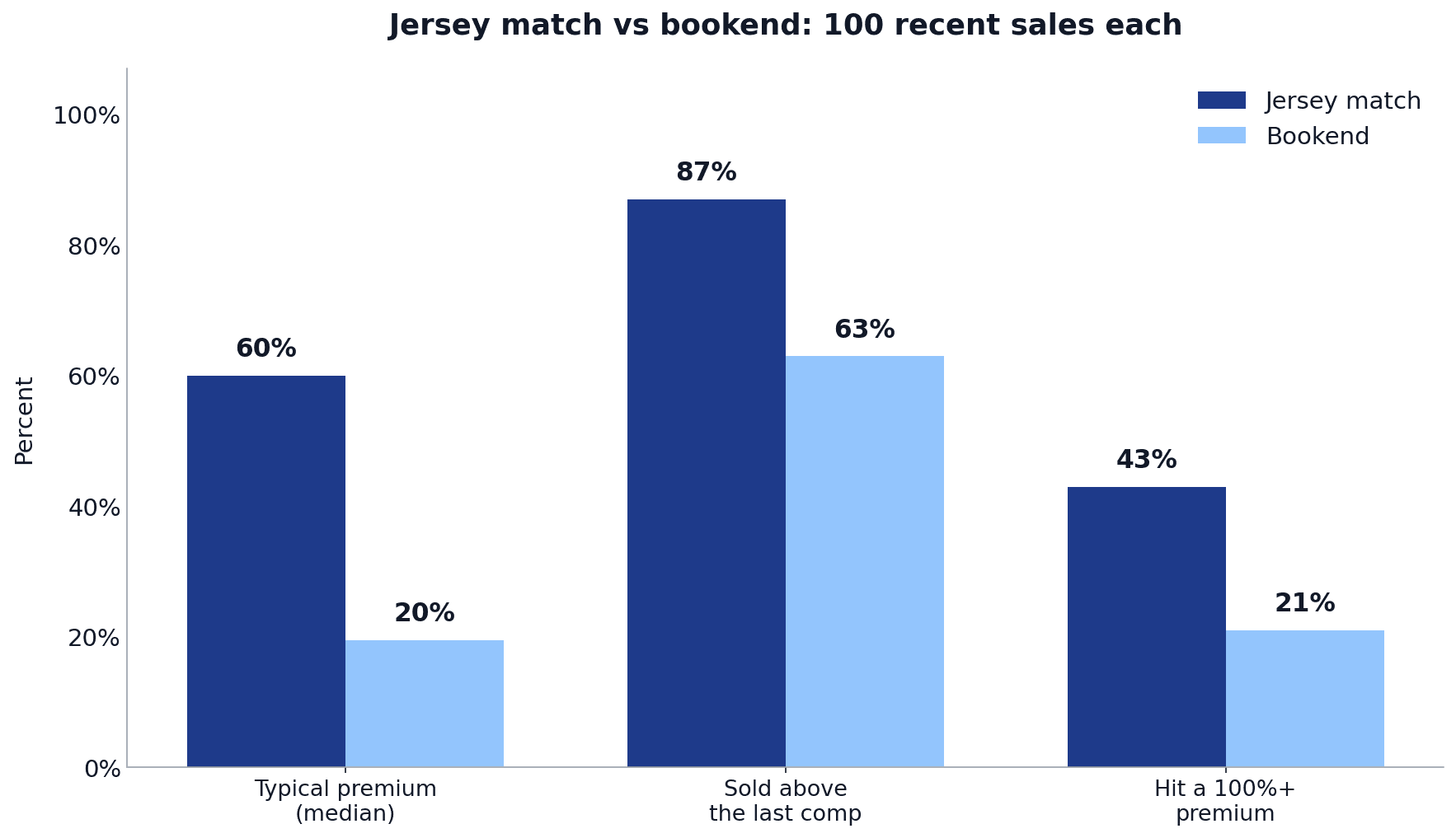
Jersey match typical premium: 60%. Bookend: 20%. Jersey matches beat their comp 87% of the time versus 63% for bookends. Both numbers come from 100-sale analyses. Here's the full head-to-head, plus the one scenario where bookends win.
Published July 11, 2026
Short answer: jersey match cards win decisively. We ran the identical 100-sale analysis on both. Jersey matches sold at a typical (median) premium of 60% over their comp; bookends at 20%. Jersey matches beat their comp 87% of the time; bookends 63%. Jersey matches hit a 100%+ premium 43% of the time; bookends 21%. Jersey match wins on premium size, reliability, and rarity. There is one scenario where bookends actually beat jersey matches, and one rare category where a single card is both at once. Full head-to-head below.
Quick refresher on both terms
A jersey match is a serial-numbered card where the numerator matches the player's jersey number. LeBron wears 23, so 23/99 is a jersey match for LeBron. Brady wore 12, so 12/99 is his match. Full explainer in our jersey match card article.
A bookend is either the first copy (1/X) or the last copy (X/X) of a print run. On a /99 card, the bookends are 1/99 and 99/99. Full explainer in our bookend card article.
Both are considered premium copies within any given parallel. The market treats them very differently in terms of price.
The head-to-head
Comparing the two across the axes that actually matter to collectors:
- Typical premium over off-number copy:
Jersey match: 60% median (average 158%, or 2.6x) across a 100-sale analysis
Bookend: 20% median (average 58%) across a 100-sale analysis
Winner: Jersey match, roughly 3x the typical premium - Rarity per parallel:
Jersey match: 1 copy per parallel
Bookend: 2 copies per parallel (1/X and X/X)
Winner: Jersey match, twice as rare - Availability across the hobby:
Jersey match: exists only if print run ≥ player's jersey number
Bookend: exists in every serial-numbered parallel with N > 1
Winner: Bookend, more parallels have them - Dedicated buyer pool:
Jersey match: large, active sub-niche of collectors specifically chase these
Bookend: smaller collector base, less coordinated demand
Winner: Jersey match - Consistency (does the premium reliably show up?):
Jersey match: sold above the comp 87% of the time (only 13% at a loss)
Bookend: sold above the comp 63% of the time (37% at a loss)
Winner: Jersey match, far more predictable
Score: Jersey match 4, Bookend 1. The one bookend win (availability) is a tiebreaker only when you can't find a jersey match, not a reason to prefer bookends when both exist. For the full data behind these numbers, see our jersey match premium analysis and bookend premium analysis.
Why jersey match commands a much bigger premium
Three reasons:
1. Direct player identity. A jersey match ties the specific card to the player in a way no other serial can. The 23/99 LeBron becomes the LeBron of that print run. That emotional connection drives buyers to stretch beyond rational pricing. A bookend has scarcity appeal but not the same identity link.
2. Truly unique per parallel. There is exactly one 23/99 LeBron in a given parallel. Every other numerator (2/99, 47/99, etc.) is just a number, but 23/99 is a one-of-one-within-the-parallel. Bookends are a two-of-one-within-the-parallel, which is scarce but not unique.
3. Coordinated demand. Jersey match collecting is a defined sub-niche with active hunters. When a 23/X LeBron hits eBay, dedicated jersey-match collectors are watching for it. Bookend collecting exists but is more diffuse and less coordinated.
For a detailed value breakdown with real sales data, see our jersey match premium analysis and our bookend premium analysis of 100 recent sales.
The one scenario where bookends beat jersey matches
Bookends win in two specific situations. Both are edge cases, but they matter enough that PC collectors should know them.
Scenario 1: Print run too small for a jersey match to exist. If the player's jersey number is larger than the print run size, no jersey match copy exists. Example: Aaron Judge wears 99. On any parallel with print run 5, 10, 25, 49, 50, or 75, there's no card stamped 99/X because X isn't large enough. But bookends always exist for those parallels (there's always a 1/X and an X/X). So for high-number players in low-numbered parallels, bookends are your only serial-based chase.
Same logic applies to other high-number stars: Wayne Gretzky (99), Aaron Donald (99), and college/rookie players who haven't received a jersey yet.
Scenario 2: Cheap cards where auction dynamics amplify bookend premiums. Our analysis of 100 recent bookend sales found that 60% of cards with a previous comp under $5 hit 100%+ bookend premiums, versus 0% of cards with a previous comp over $200. On cheap cards, small-dollar auctions attract casual bidders with no anchor, and bookend narratives can push final sale to 5-10x the last comp. That kind of percentage-based upside rarely happens with jersey matches on expensive cards, because savvier buyers cap what they'll pay.
So on a $3 rookie card, a bookend might hit +400%. A jersey match of that same $3 card might only hit +200% (because even the jersey-match buyer pool caps at a certain absolute dollar amount on cheap cards).
The rare combo: when a card is both
The single most valuable category of matched card is when the player's jersey number equals the print run total. In that case, the last-copy bookend IS also the jersey match. Both attributes stack into a single card.
Examples:
- Michael Jordan 23/23: jersey match + last-copy bookend
- Kobe Bryant 24/24: jersey match + last-copy bookend
- Aaron Judge 99/99: jersey match + last-copy bookend
- Patrick Mahomes 15/15: jersey match + last-copy bookend
- Cristiano Ronaldo 7/7: jersey match + last-copy bookend
- LeBron James 23/23: jersey match + last-copy bookend
These triple-stack combos (color-matched Prizm + jersey match + bookend) can sell for 20x or more the standard rate for their parallel. If you find one on a star player, treat it as the definitive chase card for that release.
Practical takeaways for buyers, sellers, and PC builders
If you're a buyer with a fixed budget: chase jersey matches first. They command roughly triple the typical premium and sold above their comp 87% of the time, versus 63% for bookends. The bookend analysis showed a 37% loss rate against comp, so paying a bookend premium isn't always defensible; a jersey match premium usually is.
If you're a seller with both types of copies: list the jersey match at auction with a clear title that calls out the player's jersey number connection. List the bookend with a hopeful reserve but expect it to sell closer to the previous comp unless the card is cheap enough to attract auction dynamics.
If you're building a PC: mix both. Chase jersey matches on stars where the print run allows it. Fill in with bookends on parallels where the jersey match doesn't exist (or is already spoken for). And keep an eye out for the rare triple-stack combos where both concepts overlap.
If you're hunting via eBay: both are hard to find via keyword search because sellers rarely include specific serials in listing titles. Serial Scout indexes every listing by exact numerator and denominator, so you can find jersey matches and bookends whether or not the seller called them out. See our guide to searching by serial number for the workflow.
Common questions
Which is worth more, a bookend card or a jersey match card?
Jersey match cards, by a wide margin. In matched 100-sale analyses, jersey matches had a typical (median) premium of 60% over their comp versus 20% for bookends. Jersey matches also sold above their comp 87% of the time versus 63% for bookends, and hit a 100%+ premium 43% of the time versus 21% for bookends. On the same card, the jersey match commands roughly triple the typical premium and does so far more reliably.
Which is rarer, a bookend card or a jersey match card?
Jersey match is rarer per parallel. Every print run has exactly two bookends (the 1/X and the X/X copies) but exactly one jersey match (only the copy whose numerator equals the player's jersey number). So a /99 print run has 2 bookends and 1 jersey match. There's a caveat: if the player's jersey number is larger than the print run size (e.g., Aaron Judge wears 99, so a /25 parallel of his has no jersey match), the jersey match doesn't exist for that specific parallel.
When is a bookend card worth more than a jersey match?
Two scenarios. First, when the player's jersey number is high enough that low-numbered parallels can't produce a jersey match (a /5 parallel of Aaron Judge has no jersey match, but always has bookends). Second, when the card is inexpensive to begin with: a $2 base card that has a bookend can hit auction premiums of 300%+ because the small dollar amounts attract casual bidders. Expensive cards ($50+) don't see this effect and bookends rarely beat jersey matches there.
Can a card be both a bookend and a jersey match at the same time?
Yes, and those are among the most valuable cards in modern collecting. When the player's jersey number equals the print run total, the last-copy bookend is also the jersey match. Examples: Michael Jordan 23/23, Kobe Bryant 24/24, Aaron Judge 99/99, Patrick Mahomes 15/15. These stack two collector attributes into a single copy and routinely sell for many multiples over any other copy in the print run.
How much premium does a bookend card actually add?
In an analysis of 100 recent eBay bookend sales, the typical premium was 20% over the most recent non-bookend comp of the same card. 63 out of 100 sold above the previous comp for that card. 21 hit 100%+ premiums. 37 sold below the previous comp for that card (bookend premium isn't guaranteed). Full breakdown in our bookend premium analysis.
Which is easier to find on eBay?
Bookends are more available (2 per parallel vs 1 per parallel for jersey matches). Both are difficult to find via eBay's built-in keyword search because sellers usually don't include the specific serial number in the listing title. Serial Scout was built to solve this: it searches every listing by exact numerator and denominator, whether or not the seller put it in the title.
Start exploring
To browse each type on eBay right now, check every first-copy bookend (1/X), hunt Aaron Judge jersey matches, Patrick Mahomes jersey matches, or use Serial Scout to filter by any player and preferred print run. For the deeper reads on each concept, see our full explainer on bookend cards and our full explainer on jersey match cards.