
Analysis
The Bookend Card Premium: Analyzing 100 Recent eBay Sales
The bookend premium is real but noisy. Typical sale: 20% premium. 21 of 100 sold at more than double the last non-bookend comp. 37 sold below it. Here's the full breakdown.
Published July 7, 2026
A bookend card is the first (1/X) or last (X/X) copy of a print run. Collectors treat them as premium versions of any given parallel, and the conventional wisdom is that they sell for roughly 10-30% more than a middle-of-the-run copy. That number gets thrown around a lot, but I couldn't find it backed by real sales data anywhere. So I pulled 100 recent bookend sales off eBay and compared each one to the most recent non-bookend sale of the exact same card in the prior three months.
The short version: the typical bookend sold at about a 20% premium over the last non-bookend comp of the same card, but the range is enormous. 63 out of 100 sold above the last comp. 21 hit a 100%+ premium. 37 sold below the last comp. Below is the full breakdown.
Methodology
For each of 100 completed eBay sales, I required:
- The card was a bookend: either
1/XorX/XwithX > 2. 1/1 and /2 print runs were excluded because every copy in those runs is itself a bookend, so there's no non-bookend copy to compare against. - A comparable non-bookend sale of the exact same card (same year, set, player, parallel, print run) sold on eBay within the prior three months.
- The comparison sale was NOT itself a bookend copy.
The premium is calculated as (bookend price - prior sale price) / prior sale price. A 100% premium means the bookend sold for double the prior comparable sale. A -50% premium means it sold for half.
Headline: 63% of bookends sold for more
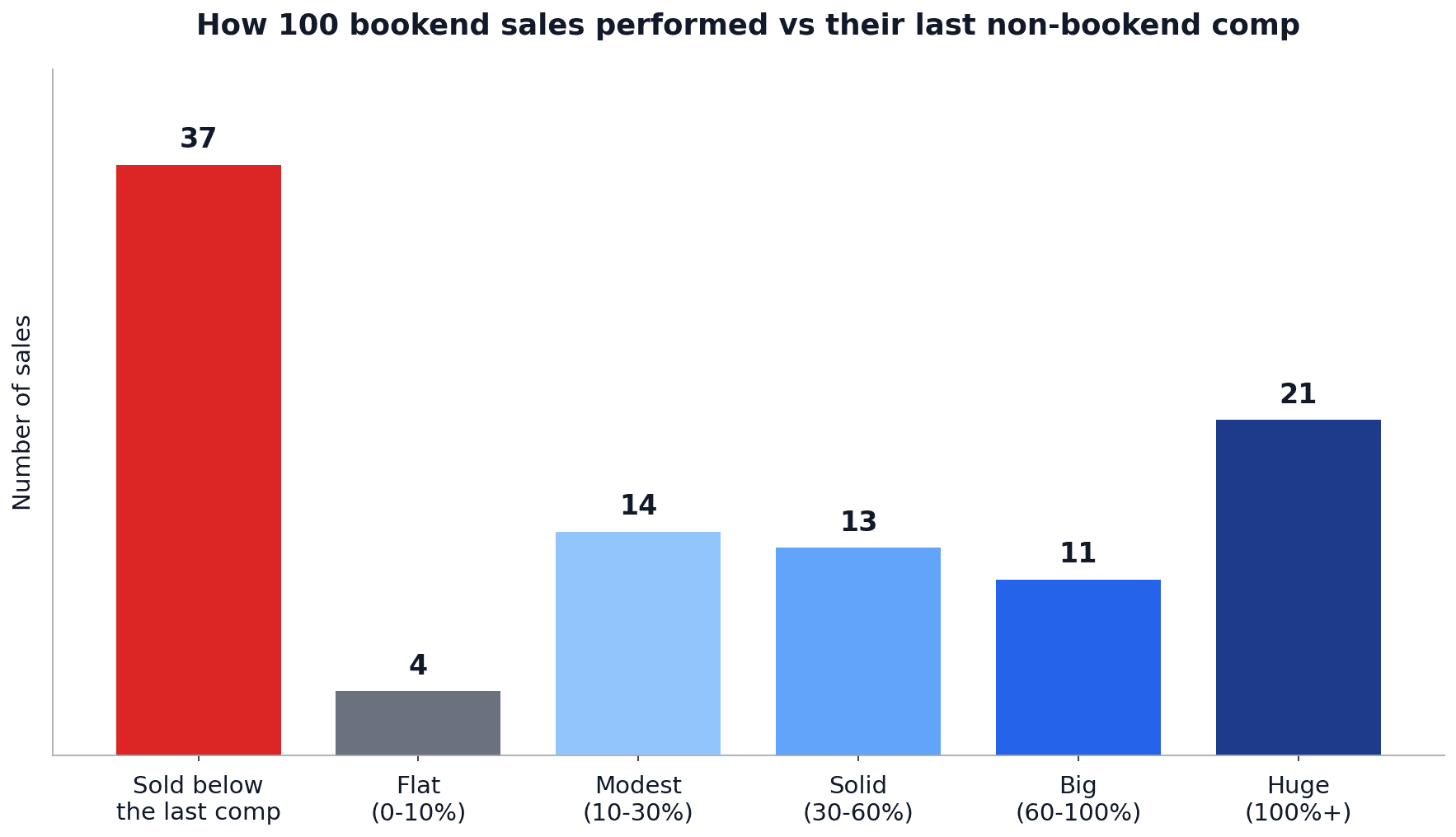
63 out of 100 bookends sold at a premium. The other 37 sold at a discount to their most recent non-bookend comparable. That's the honest floor: even a bookend is more likely than not to command a premium, but it's a coin flip that skews positive, not a guarantee.
The distribution:
- Loss (below prior sale): 37 cards
- Flat (0-10% premium): 4 cards
- Modest (10-30% premium): 14 cards
- Solid (30-60% premium): 13 cards
- Big (60-100% premium): 11 cards
- Huge (100%+ premium): 21 cards
The huge-premium tail is where the outlier value lives. 21 cards sold for at least double their prior comparable, and a handful sold for 3x to 9x. Those wins are rare but big enough to shape how the market values bookends overall.
The typical premium is 20%. The tail is where the outliers live.
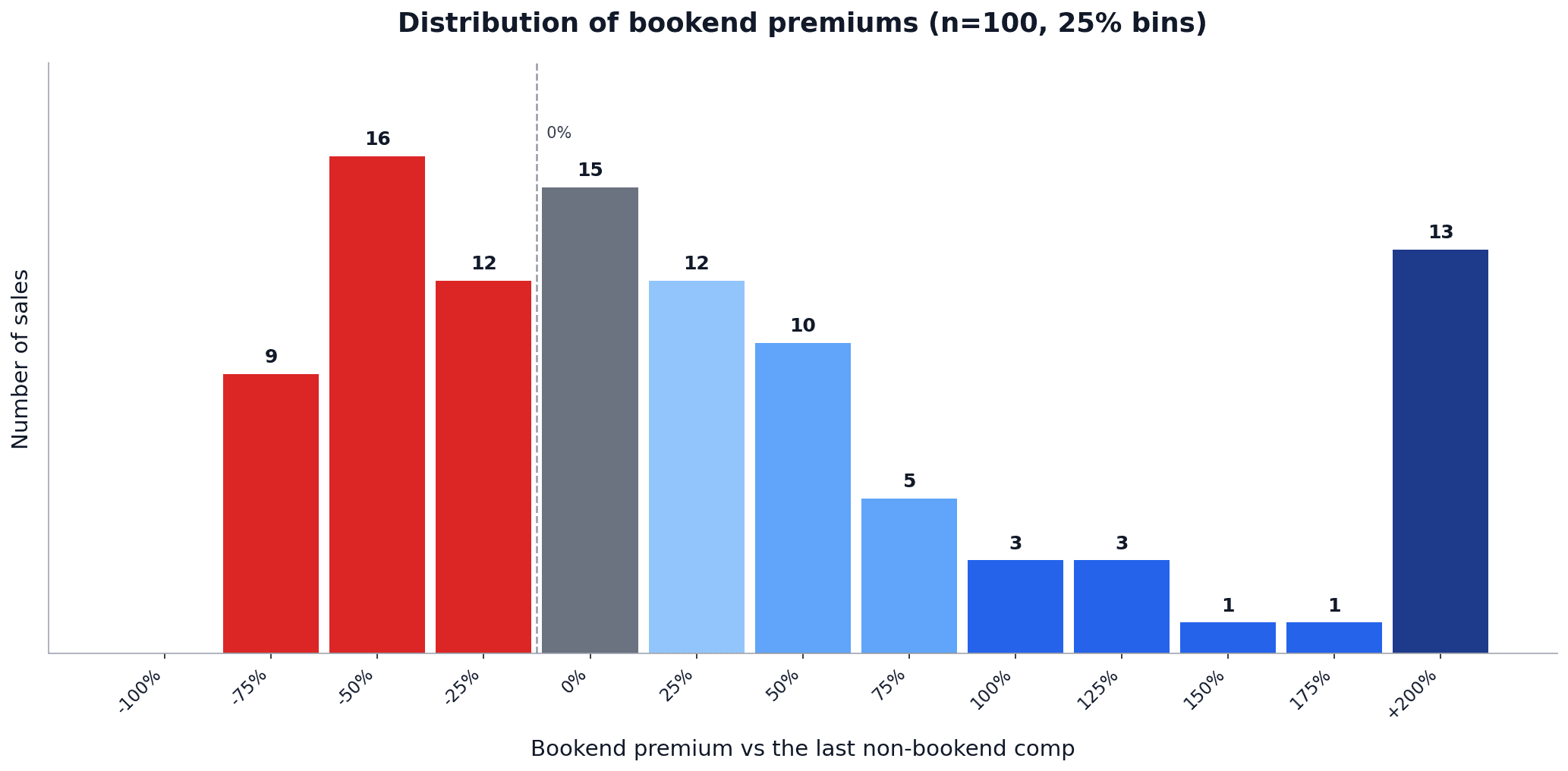
Half of bookend sales beat a 20% premium, half fell below. That's the typical outcome, and it's the number to anchor on if you're pricing a bookend to sell or deciding whether a premium is fair when buying.
The variance around that typical case is enormous. The middle half of sales landed between a 25% loss and an 82% gain. 21 sales hit a 100%+ premium. 5 sales cleared 300%. On the other end, 37 sold below the last comp and 5 sold for less than half of it.
If you sold a hundred bookends over a year, the actual result you experience across all of them would end up higher than 20% because those tail wins pull the total up. But for any one sale, 20% is the number to expect.
1/X vs X/X: same typical premium, different shape
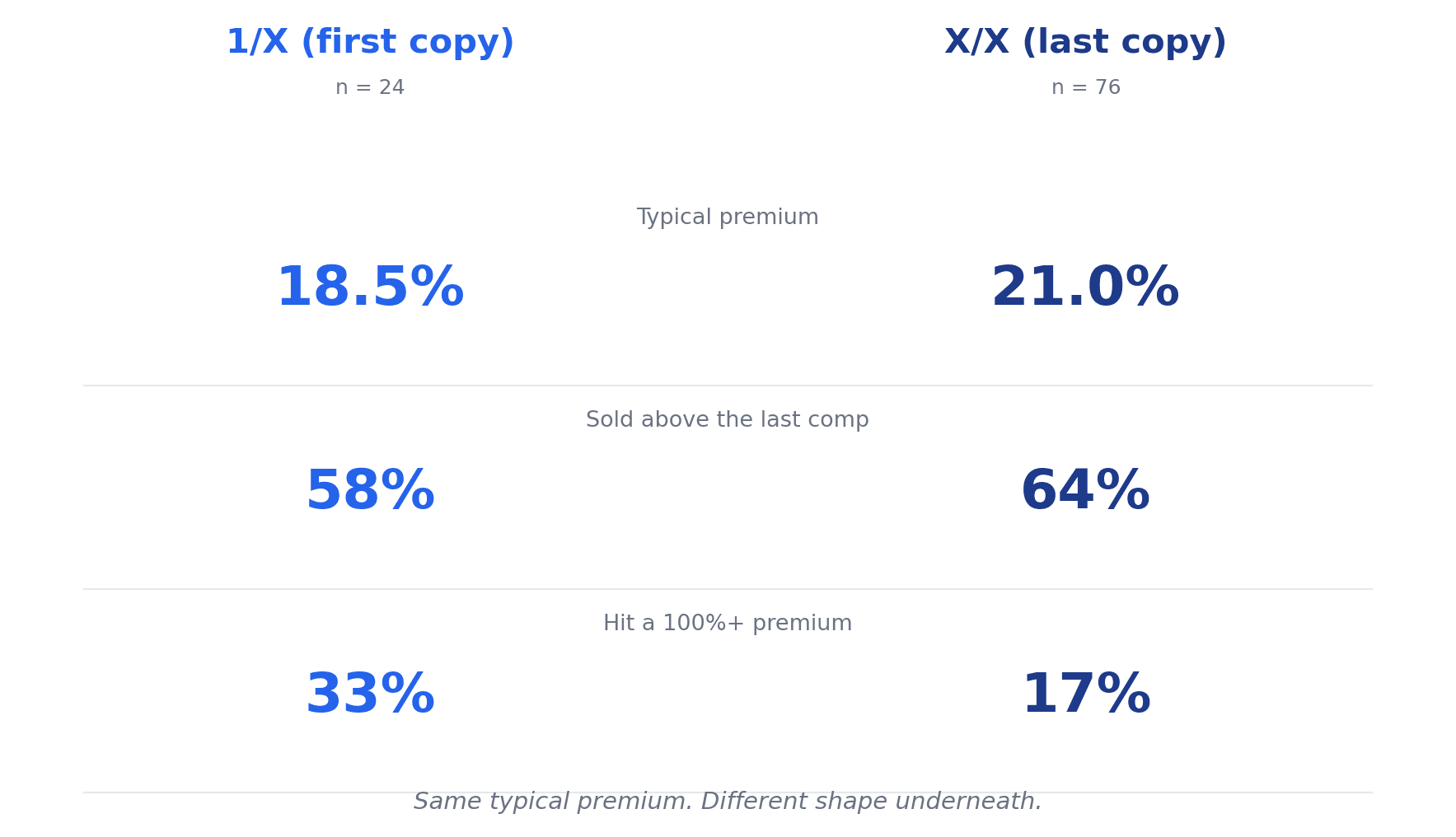
Some collectors argue the first copy of a print run carries more prestige than the last. The typical premium is the same for both:
- 1/X (first copy): n=24, typical premium 18.5%
- X/X (last copy): n=76, typical premium 21.0%
The typical premium is essentially identical. But the underlying shape is different in ways that matter for how you actually price and hunt these:
- Positive rate: X/X wins slightly. 64% of X/X copies sold above the last comp vs 58% of 1/X copies. Last-copy bookends sold above their comp more often, but not by a huge margin.
- Volatility: 1/X is much more binary. 33% of 1/X copies hit a 100%+ premium, compared to only 17% of X/X copies. But 42% of 1/X copies sold below the last comp, vs 36% of X/X. 1/X copies more often go big or go home. X/X copies cluster closer to the typical case.
- Ceiling: X/X had the single biggest premium (+823%), but 1/X copies clustered more heavily in the tail. The biggest 1/X was +271%. On any given sale, X/X can pop harder, but 1/X copies land in the "huge" bucket more consistently as a share of sample.
- Sample bias worth noting. The dataset has 76 X/X copies but only 24 1/X copies, roughly 3:1. That imbalance likely reflects listing behavior: sellers seem to call out "bookend" in the listing title less often for first copies than for last copies, so 1/X copies are harder to find in a title-based search even when they're on the market.
Practically, this means: if you're a seller with an X/X copy, expect a modest but reliable premium bump. If you have a 1/X, listing at auction is the play, because the tail is where the value lives and fixed-price listings rarely capture it. If you're a buyer, X/X is the safer entry, 1/X is the higher-variance play.
The sweet spot: /51 to /150
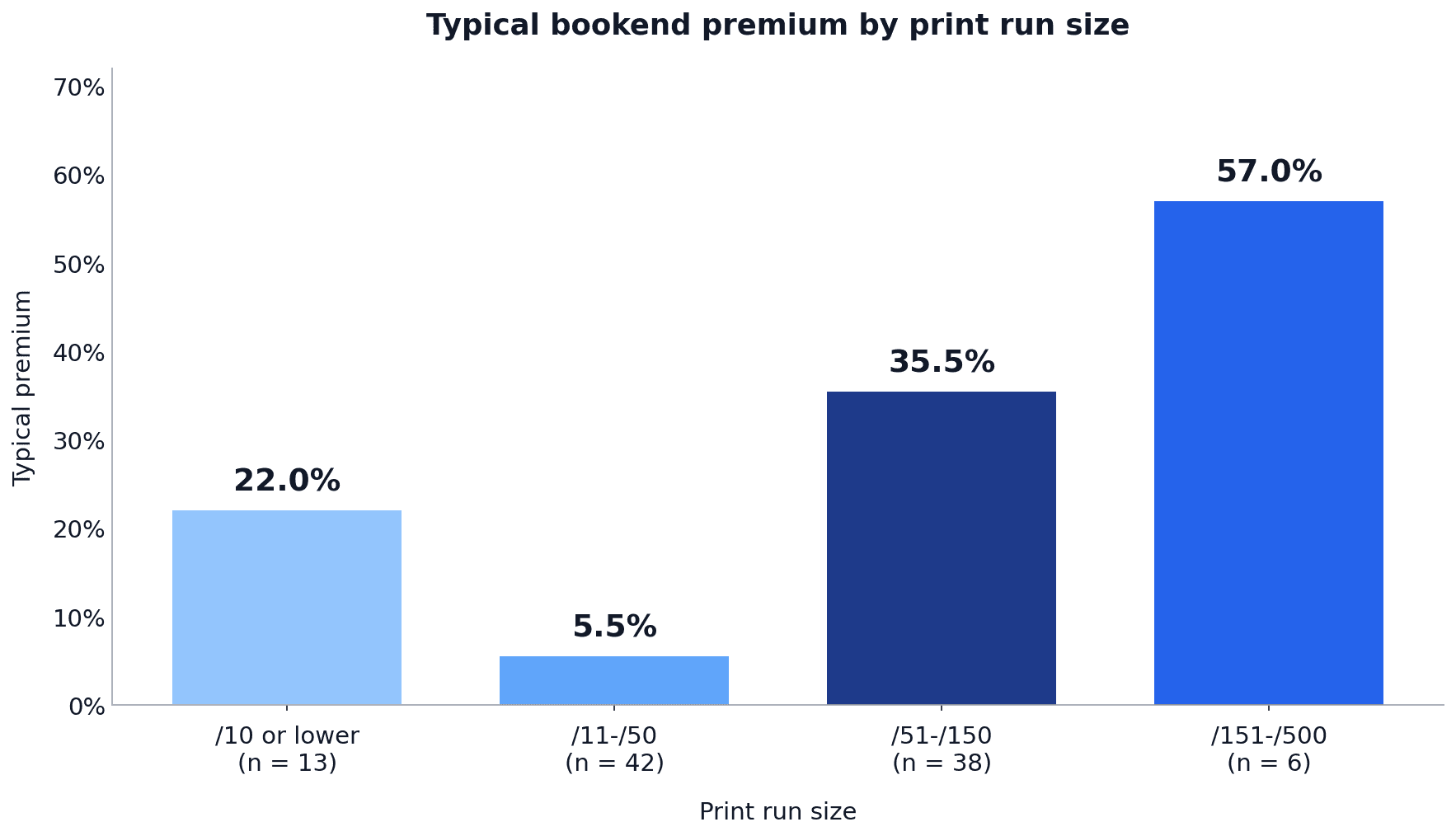
Bookend premium isn't consistent across print run sizes. The largest premiums showed up on mid-tier parallels, not the rarest ones.
- /10 or lower: n=13, typical premium 22.0%
- /11 to /50: n=42, typical premium 5.5%
- /51 to /150: n=38, typical premium 35.5%
- /151 to /500: n=6, typical premium 57.0%
- Above /500: n=1 (a single large-run sale, too few for a meaningful typical premium)
The counter-intuitive part: the rarest bookends (/10 and lower) had a smaller typical premium than mid-tier print runs. My best guess for why is that low-numbered parallels already carry a heavy scarcity premium in the base sale, so the additional bookend uplift has less room to run. A /5 card is already selling near its ceiling. A /99 card has more headroom for a bookend to add value on top.
If you're building a bookend PC and want to maximize expected premium, focus on /99, /150, and other mid-tier print runs, not the rarest parallels.
The wins: bookends that popped
The top of the distribution has some genuine outliers. The biggest premiums in the dataset:
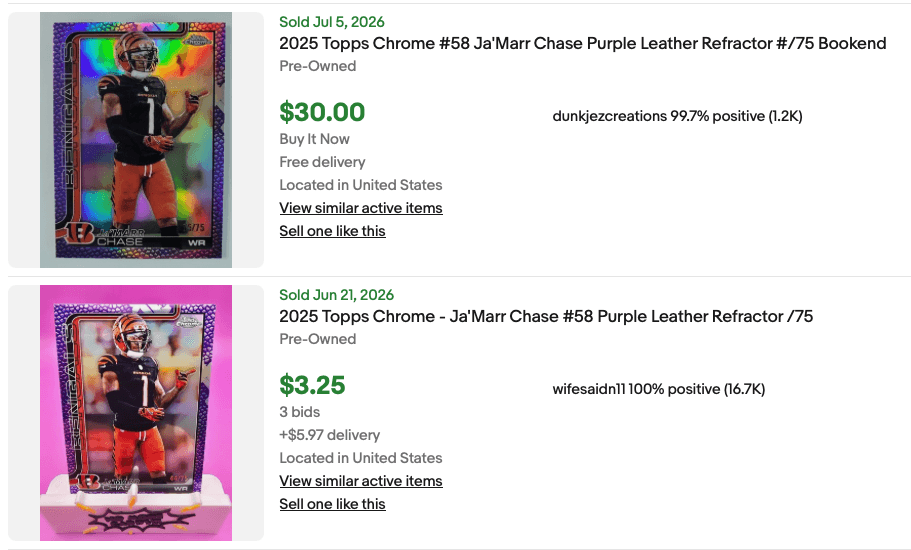
- +823%: 2025 Topps Chrome Ja'Marr Chase 75/75 Purple Leather Refractor: $3.25 → $30.00
- +708%: 2025 Panini Silhouette Garrett Nussmeier 49/49 Superstars: $0.99 → $8.00
- +360%: 2026 Bowman Chrome Warren Calcano 50/50 Gold Mojo Refractor: $8.70 → $40.00
- +329%: 2023 Topps Midnight Naz Reid 99/99: $0.99 → $4.25
- +300%: 2026 Topps Flagship Matt Shaw Green 99/99: $2.00 → $8.00
The pattern behind the outliers: cheap cards. For the 21 huge-premium cards, the median price of the most recent non-bookend sale was $4.00. For everything else it was $19.99. Cards where the most recent non-bookend sold under $5 hit huge premiums at a 60% rate. Cards where it sold over $200 hit them 0% of the time.
The full breakdown, grouping by the price of the most recent non-bookend sale:
- ≤ $5: 60% hit a 100%+ premium (12 of 20)
- $5-$15: 19% (6 of 31)
- $15-$50: 4% (1 of 23)
- $50-$200: 12% (2 of 17)
- Over $200: 0% (0 of 9)
Two things are driving this. First, small-dollar math amplifies wins. A $2 card turning into a $10 bookend sale is a 400% premium; that same $8 uplift on a $100 card is only 8%. Second, auction dynamics work differently on cheap cards. A bookend on a $200 card competes against savvy buyers with price ceilings. A bookend on a $3 card can attract multiple casual bidders with no anchor, and a bidding contest can close at 5-10x the last comp before anyone rethinks it.
The practical read: if you're auction-listing a cheap card (under $10) with real player demand, the bookend premium has enormous upside. If you're listing a card whose most recent non-bookend sale was over $200, treat bookend status as a modest and unreliable bump, not a lottery ticket.
The losses: bookends that underperformed
37% of bookends in the sample sold for less than the most recent comparable non-bookend sale. Some by a lot. The biggest losses:
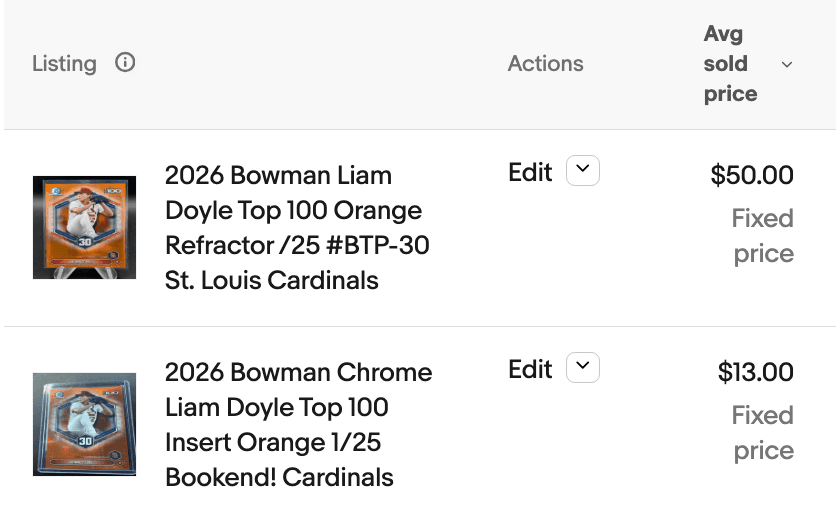
- -74%: 2026 Bowman Chrome Liam Doyle 1/25 Top 100 Orange: $50.00 → $13.00
- -71%: 2021 Select Robbie Lawler 1/10 Gold: $120.00 → $35.31
- -70%: 2026 Donruss Geoff Bodine 1/25 Signature Series: $23.00 → $6.99
- -70%: Topps Signature Class 2025 Azareye'h Thomas 25/25: $10.00 → $3.00
- -69%: 2022 Leaf Trinity Brady House 5/5 Steel Auto: $4.00 → $1.25
The pattern here is different. Losses cluster on higher-priced cards of niche players (prospects, retired athletes, non-star veterans). If a card's underlying demand is weak, the bookend premium doesn't rescue it. Player demand still dominates.
What this means for buyers and sellers
A few practical takeaways from the data:
If you're pricing a bookend to sell: anchor on the last comparable non-bookend sale and add 20%. That's the typical outcome. Above that is the top half of sales, below is the bottom half. Setting an aspirational 60%+ premium on a fixed-price listing means you're relying on the outlier tail to close the sale, and 40% of the time it won't.
If you're buying: paying a 20% premium for a bookend copy of a card with real player demand is usually defensible on resale. Paying a 60%+ premium is a bet on continued player demand, and the data shows that bet loses roughly a third of the time.
If you're building a PC: mid-tier print runs (/50 to /150) offer the best combination of expected premium and available supply. The rarest bookends (/5, /10) already carry heavy pricing from scarcity alone, and the additional bookend uplift is smaller.
If you're auction-listing: the outlier tail is real. Cards under $10 in cost basis have the highest ratio-based upside, since even a modest final sale of $30-50 shows up as a 300%+ premium in the data. Auction is where the tail plays out.
Finding bookend cards on Serial Scout
The hardest part of hunting bookends on eBay isn't buying one, it's finding one in the first place. Most sellers list a bookend without calling out the specific serial in the title. They'll write "2023 Prizm Blue /99 Aaron Judge" and leave out whether the copy is 1/99, 47/99, or 99/99. If you're searching for 99/99 or 1/99 in eBay's keyword search, those listings never surface, even when the bookend is sitting right there in the photo.
Serial Scout was built to fix exactly this. Every serial-numbered card listed on eBay is searchable by its exact numerator and denominator, whether or not the seller put it in the title. That means you can pull every currently listed bookend in a couple of clicks.
A few bookend hunts worth trying:
- Browse every first-copy bookend (1/X) currently on eBay across all print runs and players in one page.
- Filter for a specific print run of first copies, like 1/99 or 1/25.
- For last-copy bookends, set both the numerator and denominator to the same value in the search filters. Every currently listed 99/99 or 25/25 across every player and set is one search away.
- Add a player name to any of the above to narrow to a specific PC target.
For long-term hunts (the specific bookend you want isn't listed right now but might list in three months), set up an alert. When a card matching your criteria hits eBay, you get an email within the hour instead of scrolling through listings every week.
Common questions
Do bookend cards actually sell for more than off-number copies?
In this analysis of 100 recent eBay bookend sales, 63 out of 100 sold for more than a comparable non-bookend sale of the same card in the prior three months. The typical premium was 20%, though results ranged from a 74% loss to an 823% gain.
Which is worth more, 1/X or X/X?
The typical premium is roughly the same for both. 1/X copies had an 18.5% typical premium; X/X copies had 21.0%. But the shape is different: X/X copies sold above the last comp 64% of the time (vs 58% for 1/X), while 1/X copies were more likely to hit a huge premium of 100%+ (33% of 1/X vs 17% of X/X). X/X is more consistent, 1/X is more binary.
What print run size gets the biggest bookend premium?
Mid-tier print runs (/51 through /150) had the biggest typical bookend premiums at 35.5%. Print runs of /10 or less had smaller typical premiums (22.0%), likely because low-numbered parallels already carry a scarcity premium that's built into their normal selling price.
Do cheaper cards get bigger bookend premiums than expensive ones?
Yes, dramatically. Cards where the most recent non-bookend sale was $5 or less hit 100%+ premiums 60% of the time. Cards where the most recent non-bookend sale was over $200 hit a 100%+ premium 0% of the time in this dataset. For the 21 huge-premium cards, the median price of the most recent non-bookend sale was $4.00, vs $19.99 for everything else. Small-dollar auctions have more room for a bidding contest to close at 5-10x the last comp before buyers rethink; expensive cards have savvier buyers with tighter price ceilings.
Can a bookend card sell for less than a normal copy?
Yes, and it happens more often than you'd think. In this sample, 37 out of 100 bookends sold below their most recent comparable non-bookend sale. Bookend premium isn't guaranteed. It depends heavily on player demand, timing, and how the specific listing was marketed.
What was the biggest bookend premium in the analysis?
A 2025 Topps Chrome Ja'Marr Chase 75/75 Purple Leather Refractor sold for $30 when the most recent non-bookend copy had sold for $3.25. That's a 823% premium. Large premiums tend to appear on lower-priced base parallels where the bookend copy creates a scarcity story that inflates final auction price.
How was this data collected?
100 completed eBay sales of bookend cards (either 1/X or X/X, excluding 1/1s), each with a comparable non-bookend sale of the exact same card within the prior three months. The premium is calculated as (bookend price - most recent non-bookend price) / most recent non-bookend price.
Start exploring
To browse actual bookend inventory currently live on eBay, check our page for every card numbered 1 of X (every 1/X first copy), or use Serial Scout to filter by your player and preferred print run. For background on what bookend cards are and why the term exists, see our full explainer on bookend cards. We ran the identical analysis on jersey match cards, which command a much larger premium (typical 60% vs 20%): see the jersey match premium analysis and the head-to-head comparison. And when a card is a bookend and a jersey match at once (like a Judge 99/99), it becomes a double jersey match, which carried the biggest premium of any serial trait in a smaller first sample.