
Analysis
The Jersey Match Premium: Analyzing 100 Recent eBay Sales
Typical premium: 60%. Average: 158%. 87 of 100 sold above their comp. Common guidance says 10-30%; the data says jersey matches command far more. Full breakdown below.
Published July 13, 2026
A jersey match is a serial-numbered card where the numerator matches the player's jersey number, like a LeBron numbered 23/99 or an Ohtani numbered 17/175. The general guidance you'll hear is that a jersey match adds 10-30% over an off-number copy. We wanted to test that, so we pulled 100 recent jersey match sales off eBay and compared each one to the most recent non-match sale of the exact same card in the prior three months.
The short version: jersey matches blow past the 10-30% guidance. They're a genuinely large and genuinely reliable premium, more so than any other serial-based trait we've measured. The typical jersey match sold at a 60% premium (double the top of the usual range). 87 of 100 sold above their comp. 43 hit a 100%+ premium. Only 13 sold below their most recent comp.
Methodology
For each of 100 completed eBay sales, I required:
- The card was a jersey match: the numerator equals the player's jersey number (Ohtani 17, LeBron 23, Judge 99, etc.).
- A comparable non-match sale of the exact same card (same year, set, player, parallel, print run) sold on eBay within the prior three months.
- The comparison sale was NOT itself a jersey match.
The premium is (match price - prior sale price) / prior sale price. A 100% premium means the jersey match sold for double the comp; a -50% premium means it sold for half.
Headline: 87% sold above their comp
87 out of 100 jersey matches sold for more than their most recent non-match comp. Only 13 sold below. That's the reliability story, and it's the number that most separates jersey matches from other serial traits. For context, our bookend analysis found only 63% sold above their comp and 37% sold below it.
The distribution:
- Sold below the comp: 13 cards
- Flat (0-10%): 3 cards
- Modest (10-30%): 8 cards
- Solid (30-60%): 24 cards
- Big (60-100%): 9 cards
- Huge (100%+): 43 cards
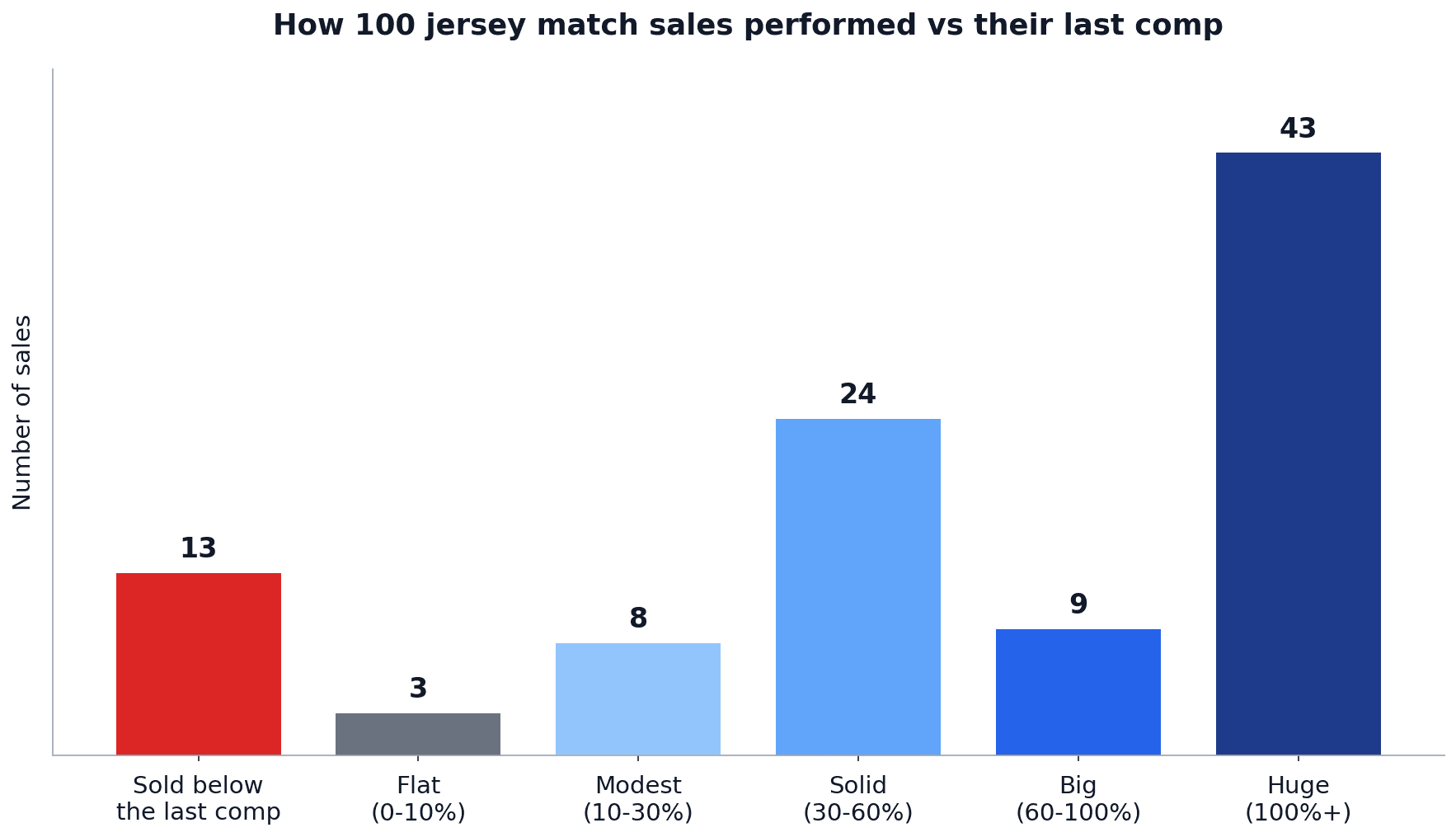
The typical premium is 60%, double the usual guidance
This is the most useful finding in the data. The common 10-30% guidance dramatically undersells jersey matches. Here's the full spread:
- Typical (median): 60% premium, or 1.6x the comp
- Average (mean): 158%, or 2.6x, pulled up by outliers
- 75th percentile: 200%, or 3x
- 90th percentile: 428%, or 5.3x
So the 10-30% guidance describes almost none of the market. The typical sale added 60%, more than double the top of that range, and 26 of the 100 sales cleared a 200% premium. If you're pricing a jersey match to sell or deciding what to pay, anchor on 60% over the last comp, not 10-30%.
The middle half of all sales landed between a 30% and a 200% premium. That's a wide band, but note where it sits: even the 25th percentile is a solid 30% gain. The floor on a jersey match is much higher than on a bookend.
The sweet spot: mid-to-large print runs
Premium size varies by print run, and the pattern is the opposite of what raw scarcity would suggest:
- /10 or lower: n=4, typical premium 42%
- /11 to /50: n=39, typical premium 54%
- /51 to /150: n=40, typical premium 111%
- /151 to /500: n=15, typical premium 200%
- Above /500: n=2 (too few for a meaningful typical premium)
The rarest parallels (/10 and lower) had the smallest percentage premium. The likely reason is the same as with bookends: a /5 or /10 card already carries a heavy scarcity premium in its base price, so the jersey-match uplift has less room to run. A /150 or /199 card has a lower base price, so the jersey match adds a much bigger percentage on top.
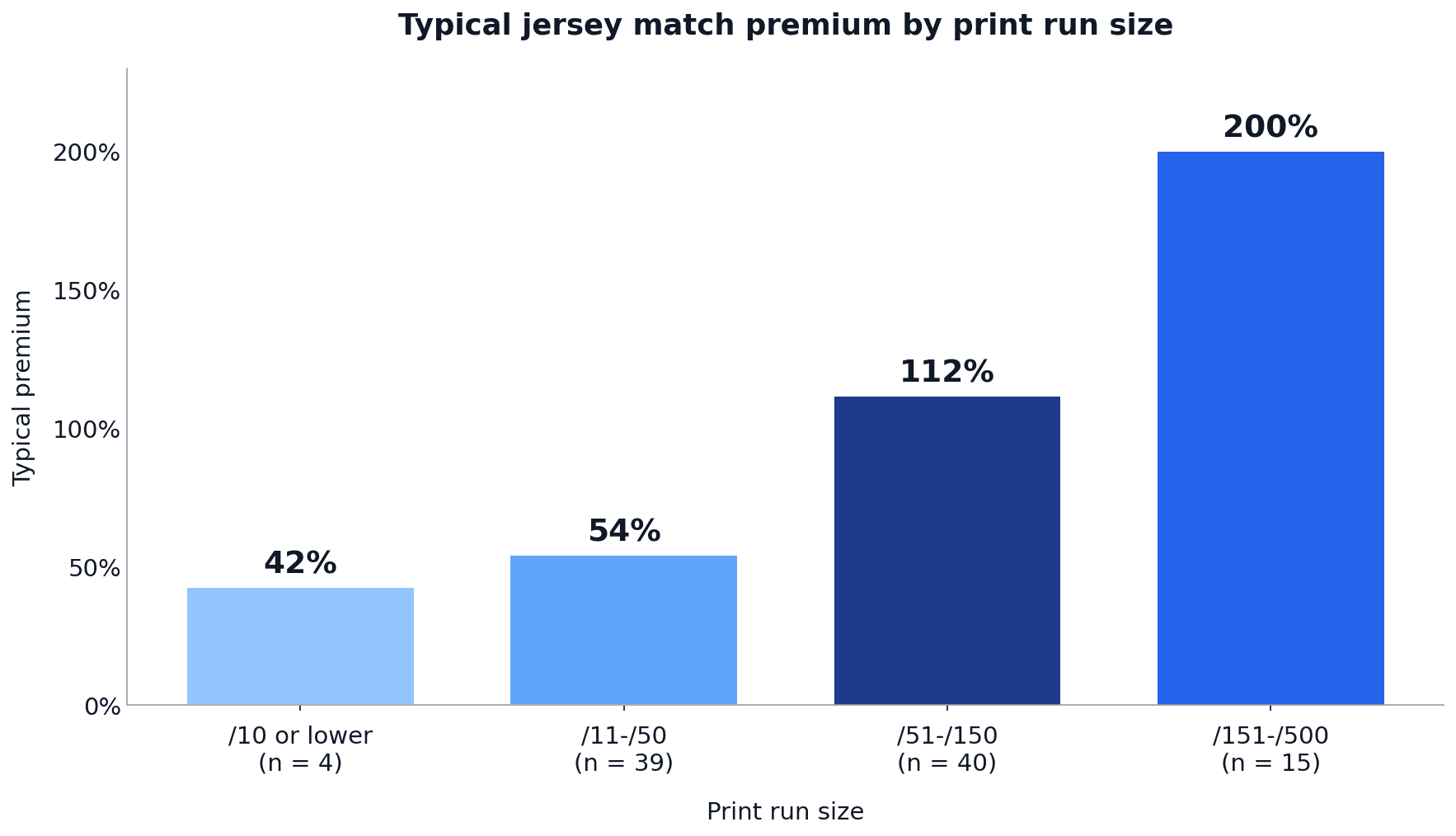
Cheaper cards, bigger percentage premiums
Same pattern as bookends, and even stronger. The 43 huge-premium cards had a median comp price of $15.50, versus$45.00 for everything else. Broken out by the price of the comparable sale:
- ≤ $5: 67% hit a 100%+ premium (median 182%)
- $5-$15: 52% (median 133%)
- $15-$50: 52% (median 100%)
- $50-$200: 27% (median 51%)
- Over $200: 10% (median 21%)
The dynamic is the same one we saw with bookends: small-dollar auctions attract casual bidders with no fixed anchor, and a jersey match narrative can push a $2 card to $13 (a 550% premium) far more easily than it can move a $480 card. On expensive cards, buyers are savvier and cap what they'll pay, so the percentage premium compresses even though the absolute dollars are larger.
The wins: jersey matches that popped
The biggest premiums in the dataset:
- +1,706%: 2025 Donruss Raven Johnson 25/35: $0.72 → $13.00
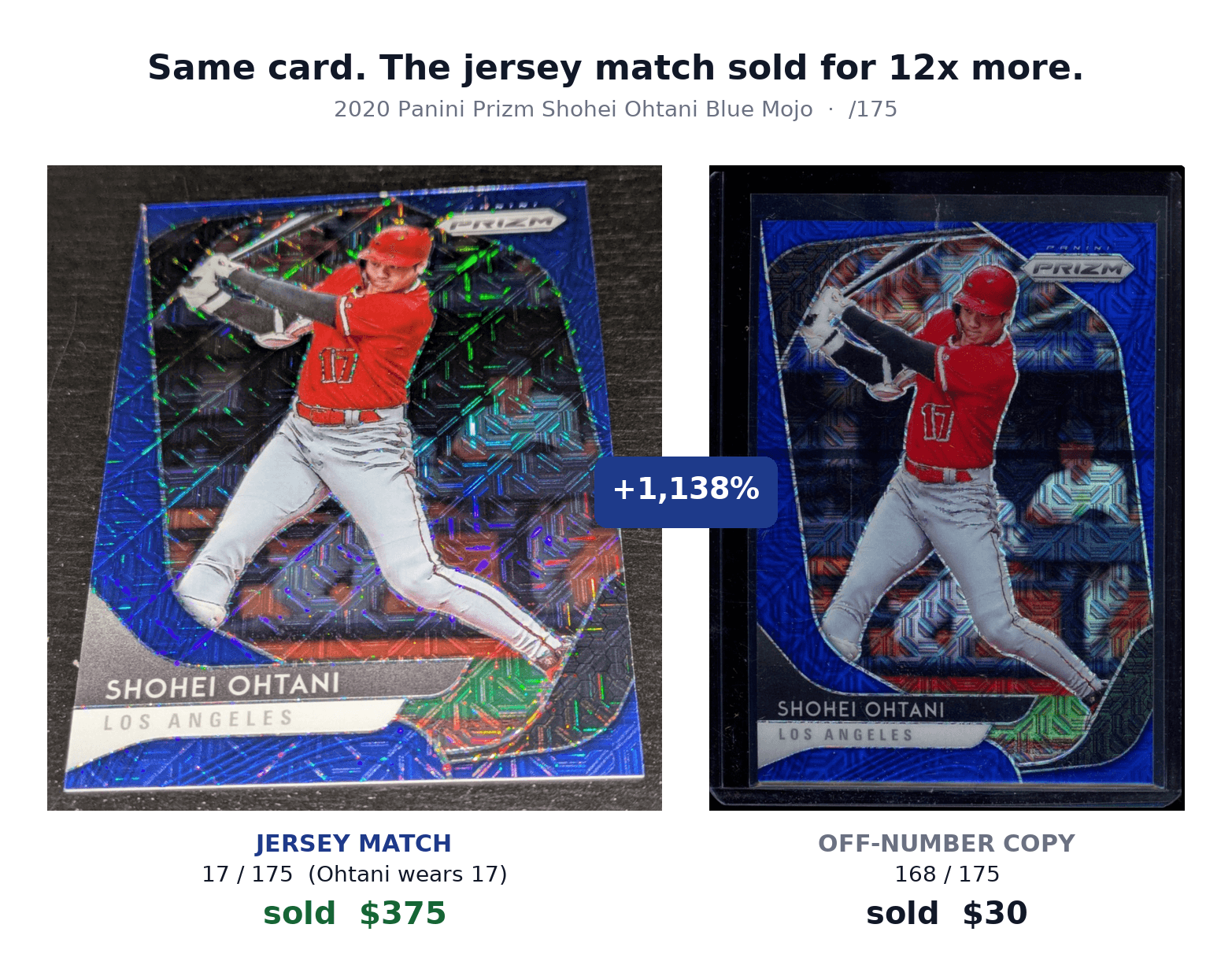
- +1,138%: 2020 Prizm Shohei Ohtani 17/175 Blue Mojo: $30.30 → $375.00 (Ohtani wears 17; a jersey match on a superstar)
- +700%: 2025 Donruss Nick Van Exel 9/99 Auto Orange: $5.00 → $40.00
- +699%: 2025 Select Sheryl Swoopes 22/99 White Prizm: $1.25 → $9.99
- +689%: 2025 Topps Chrome Davante Adams 17/50 Blue Wave: $9.50 → $75.00
The losses: jersey matches that underperformed
Only 13% sold below their comp, but they existed. The biggest losses:
- -77%: 2025 Topps Chrome Jalen Williams 8/41 Cactus Jack: $23.50 → $5.50
- -59%: 2025 Topps Finest A.J. Brown 11/125 Power Kings Purple: $5.50 → $2.25
- -58%: 2024 Prizm Erling Haaland 9/25 Norway: $480.00 → $202.50
- -50%: 2025 Topps Pristine Adael Amador 1/15 Pink: $3.25 → $1.62
- -42%: 2026 Topps Chrome Cayla Barnes 5/50 Gold Winter Olympic: $7.39 → $4.25
The pattern in the losses is instructive. The Haaland 9/25 is the standout: an expensive ($480 comp) jersey match that still lost more than half its value. When the underlying card is already priced high, the jersey match premium is a smaller share of the total and doesn't protect against a soft market or an impatient seller. Player demand and timing still dominate at the high end.
How jersey matches compare to bookends
We ran the identical analysis on 100 bookend sales. Head to head, jersey matches win decisively on every axis:
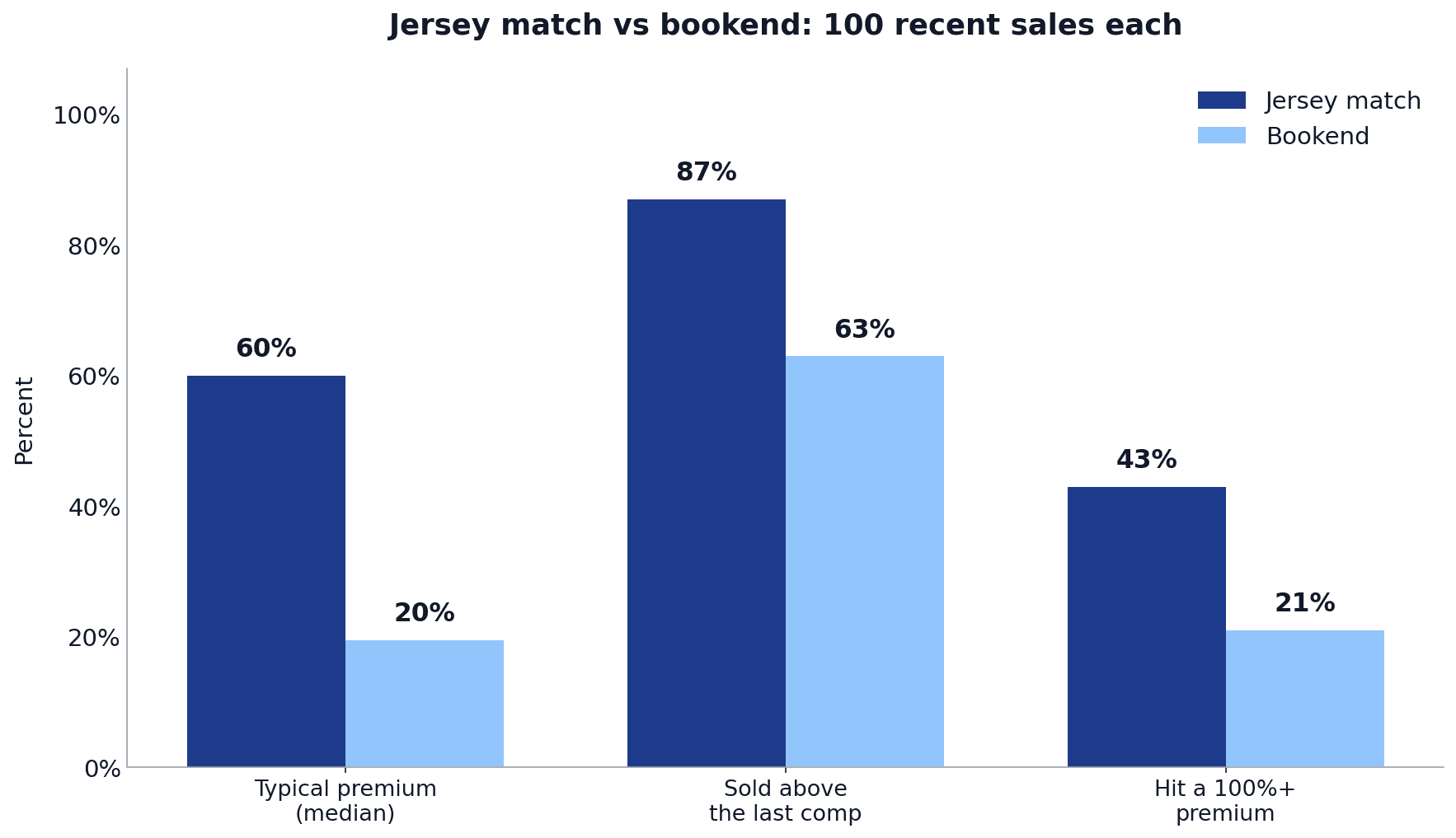
The typical jersey match premium (60%) is triple the typical bookend premium (20%), and jersey matches beat their comp 87% of the time versus 63% for bookends. For a full breakdown of when to chase each, see our head-to-head on bookend vs jersey match cards.
And if you want the extreme end, a double jersey match is a card that is a jersey match and a bookend at once, X/X where X is the player's number (Aaron Judge 99/99). In a smaller 22-sale first look, those commanded a median 187% premium, the biggest of any serial trait we've measured.
What this means for buyers and sellers
If you're pricing a jersey match to sell: anchor on the last non-match comp and add 60%. That's the typical outcome. On a star or a lower-priced card, you can reasonably push toward 2x-3x, but only 26% of sales cleared 3x, so don't treat it as the default.
If you're buying: jersey matches are the most defensible serial-based premium to pay up for. With an 87% above-comp rate, the resale risk is low relative to bookends or off-number chase copies.
If you're building a PC: mid-tier print runs (/50 to /199) give the best combination of premium size and available supply. And the biggest percentage upside is on cheaper cards, so a jersey match of a rising rookie in a $10 parallel can outperform, in percentage terms, the same player's $200 card.
Finding jersey matches on Serial Scout
The hard part is finding them. Most eBay sellers don't put the specific serial in the title, so a listing might read "2020 Prizm Blue Mojo Ohtani" without mentioning that the card is stamped 17/175 (the jersey match). Keyword searching for 17/175 misses it entirely.
Serial Scout indexes every serial-numbered listing by exact numerator and denominator, whether or not the seller called it out. So you can pull every jersey match for a player in one search. Try every Shohei Ohtani jersey match, every Aaron Judge jersey match, or every Patrick Mahomes jersey match currently on eBay.
Common questions
How much do jersey match cards sell for?
In this analysis of 100 recent eBay jersey match sales, the typical (median) premium was 60% over the most recent comparable non-match sale of the same card. The average was 158%, pulled up by outliers. 87 of 100 sold above their comp, and 43 hit a 100%+ premium. Common guidance puts the jersey match premium at 10-30%, but the data shows it runs much higher, with the typical sale adding 60% and nearly half adding 100% or more.
Are jersey match cards a reliable premium?
Yes, more reliable than most serial-based premiums. 87 out of 100 jersey matches sold above their comparable non-match sale, and only 13 sold below their most recent comp. For comparison, in our bookend analysis only 63% sold above the comp and 37% sold below it. Jersey matches beat their comp nearly nine times out of ten.
Does the common 10-30% guidance for jersey matches hold up?
No, it understates them. Common guidance suggests jersey matches add 10-30% over an off-number copy, but in this data the typical (median) premium was 60%, the 75th percentile was 200%, and the mean was 158%. Even the 25th percentile was a 30% gain. Jersey matches consistently command more than the conventional 10-30% range, and often far more.
Do cheaper cards get bigger jersey match premiums?
Yes, dramatically, in percentage terms. Cards with a comparable sale of $5 or less hit 100%+ premiums 67% of the time, versus 10% for cards with a comp over $200. Median premium was 182% on sub-$5 cards vs 21% on $200+ cards. Small-dollar auctions attract bidders with no anchor, so the percentage upside is far larger even though the absolute dollars are smaller.
What was the biggest jersey match premium in the analysis?
A 2025 Panini Donruss Raven Johnson numbered 25/35 sold for $13 when the most recent non-match copy had sold for $0.72, a 1,706% premium. The biggest premium on a recognizable star was a 2020 Prizm Shohei Ohtani Blue Mojo numbered 17/175 (Ohtani wears 17), which sold for $375 versus a $30.30 comp, a 1,138% premium.
How was this data collected?
100 completed eBay sales of jersey match cards (where the numerator equals the player's jersey number), each paired with a comparable non-match sale of the exact same card within the prior three months. The premium is calculated as (jersey match price - most recent non-match price) / most recent non-match price.
Start exploring
Browse jersey matches by player on Serial Scout, or read the companion pieces: our full explainer on jersey match cards, our bookend premium analysis, and the head-to-head comparison of the two.